
How do I read the wind or hail deductible on my homeowners declarations page?
Find the declarations that covered your address on the day of the storm. Copy the exact wind or hail entry, including its heading and any footnote. If it shows a percentage, find the amount the policy says to multiply by that percentage. For example, 2% of a $350,000 dwelling limit is $7,000. Then read the attached form that says which losses trigger that deductible. A repair estimate tells you what someone expects the work to cost. It cannot tell you which line of your insurance contract applies. [1] [2]
In this guide
Seven facts to have in front of you
1. The effective dates, insured address and insurer identify the declarations you need. Renewal paperwork can arrive before the old term ends. Start with the term covering the reported loss. [3]
2. A flat deductible is already expressed in dollars. A percentage must be applied to the value identified in the policy. The house’s insured limit and a contractor’s estimate answer different questions. [1] [2]
3. Wind, hail, hurricane and named storm can appear under different headings. The attached policy wording explains which event activates a particular deductible. [1] [4]
4. A covered loss can fall below a deductible. A payment of zero can also have another explanation. Ask which decision the insurer actually made. [2]
5. Roof depreciation and a deductible can both affect a check. Read the settlement calculation before treating every dollar of the difference as your deductible. [5]
6. Some homeowners have a separate wind policy. Some forms apply deductibles separately to listed items. Find the contract, structure and coverage involved before combining estimates. [3] [6] [7]
7. State-specific rules matter. New York’s hurricane trigger, Florida’s calendar-year provisions and North Carolina’s coastal wind coverage illustrate three different questions. A rule from one state should never become an assumption about an address in another. [6] [8] [9] [10]
1. Which declarations do I need?
Imagine opening your insurer’s app after hail cracked a skylight. The first file says “current policy.” The storm was last Thursday. The renewal started Monday. Both copies have your name, the same address and almost the same policy number. Yet one may show a different dwelling limit, deductible endorsement or roof settlement provision. Save both files. Label them with the dates printed on the first page. Put the one that includes last Thursday on top.
The declarations are a summary of the coverage issued to the named insured. They can run over several pages. A cover letter about your premium, a proof-of-insurance certificate for the lender and the first screen of an online account may each omit a line you need. Look for the insured location, policy period, limits, deductible schedule and list of attached forms. TWIA’s annotated sample is a useful exercise in finding those fields. Its lettering is specific to that product, so copy the labels from your document when making notes. [3]
What if you discovered the broken skylight today and do not know when it broke? Write down the date you first saw the damage and what you know about earlier conditions. Keep separate entries for the storm you experienced and the later observation. A photo taken Tuesday proves you made a photo Tuesday. It does not, by itself, establish that hail hit on Monday night. Tell the insurer what you know and what you are unsure about. This gives the adjuster a way to ask for evidence without turning a guess into the premise of the whole claim.
If you cannot find the policy packet, ask the insurer or agent for the declarations, endorsements and policy form that were in effect on the date you provide. Request a copy of any change effective during that term. You can ask this while reporting damage through the insurer’s normal channels. There is no reason to wait for a perfect personal worksheet before asking what notice the policy requires. [5]
2. What exactly should I copy from the page?
Work across the row as if you were going to hand it to someone who has never seen your house. Start with the insured location. Then write the heading, the percentage or dollar amount, and any words immediately beside or beneath it. Include the column header. “2%” on its own is a number. “Windstorm or hail, 2% of the dwelling limit shown for this location” is enough information to begin a calculation. That wording is an illustration. Your policy might express it differently.
Check the lines immediately above and below. One may list an all-other-perils deductible, another a wind or hail deductible and another a hurricane deductible. A policy with only one deductible is also possible. If you see a dash, an asterisk or “see endorsement,” copy it as printed. A dash can be a prompt to read a note elsewhere. It is poor evidence that the deductible is zero. Ask the insurer what the symbol means before making a financial decision based on it. [1] [4]
Here is a practical way to take notes. Make one column headed “Printed on my policy” and a second headed “My question.” In the first, put only wording you can point to. In the second, write questions such as “Is the limit at the start of the term or the date of loss used?” or “Does this line also apply to the detached garage?” If an answer comes by phone, add the name of the person and date alongside the question. Leave the wording column alone. Later, when you look back, you will still be able to distinguish something the policy says from something someone told you.
You rarely need to share the whole packet with a contractor to get an itemized repair estimate. The contractor can describe the work and price it. Your insurer can identify which policy form it uses. If you are discussing a line with an adviser, keep the original page for yourself and think about which identifiers the other person actually needs. A public online example can demonstrate the math without exposing a home address or claim number.
3. What number does the percentage multiply?
Start with the noun after “of.” If the endorsement ties the deductible to the dwelling coverage limit, find that limit on the relevant location’s declarations. If it ties the deductible to an individually scheduled item, pull that item’s number. If it refers to a value that changes over the term, ask for the value used on the loss date and how the insurer derived it. Do not fill in a missing base with the most prominent dollar amount on the page. [1] [3] [7]
For a dwelling limit of $350,000, a 2% deductible gives $350,000 × 0.02 = $7,000. One way to check the arithmetic is to find 1% first. One percent of $350,000 is $3,500, so twice that is $7,000. In the same example the roofer quoted $18,500. Applying 2% to the roofer’s price gives $370. The multiplication is correct but answers a different question. To make $370 the deductible you would need policy wording using the repair price as its base.
Market value, the unpaid mortgage and a local tax assessment can all differ from the insured dwelling limit. Suppose your house could sell for $480,000, the loan balance is $214,000, and the declarations show $350,000. All three figures may be accurate. If your policy points to the $350,000 limit, the other two figures do no work in the deductible calculation. Keep them off that line of the worksheet. The same goes for the total of dwelling, belongings and other coverage limits unless the contract actually directs you to total them. [3]
A percentage can stay the same between renewals while its dollar value grows. If the relevant limit goes from $350,000 to $390,000 and the deductible stays at 2%, the computed amount rises from $7,000 to $7,800. That is an $800 change even though neither document shows a larger percentage. When a figure on an estimate differs from the figure you remember, compare the base and the date before concluding that someone changed the percentage.
4. How does the calculation work on a real estimate?
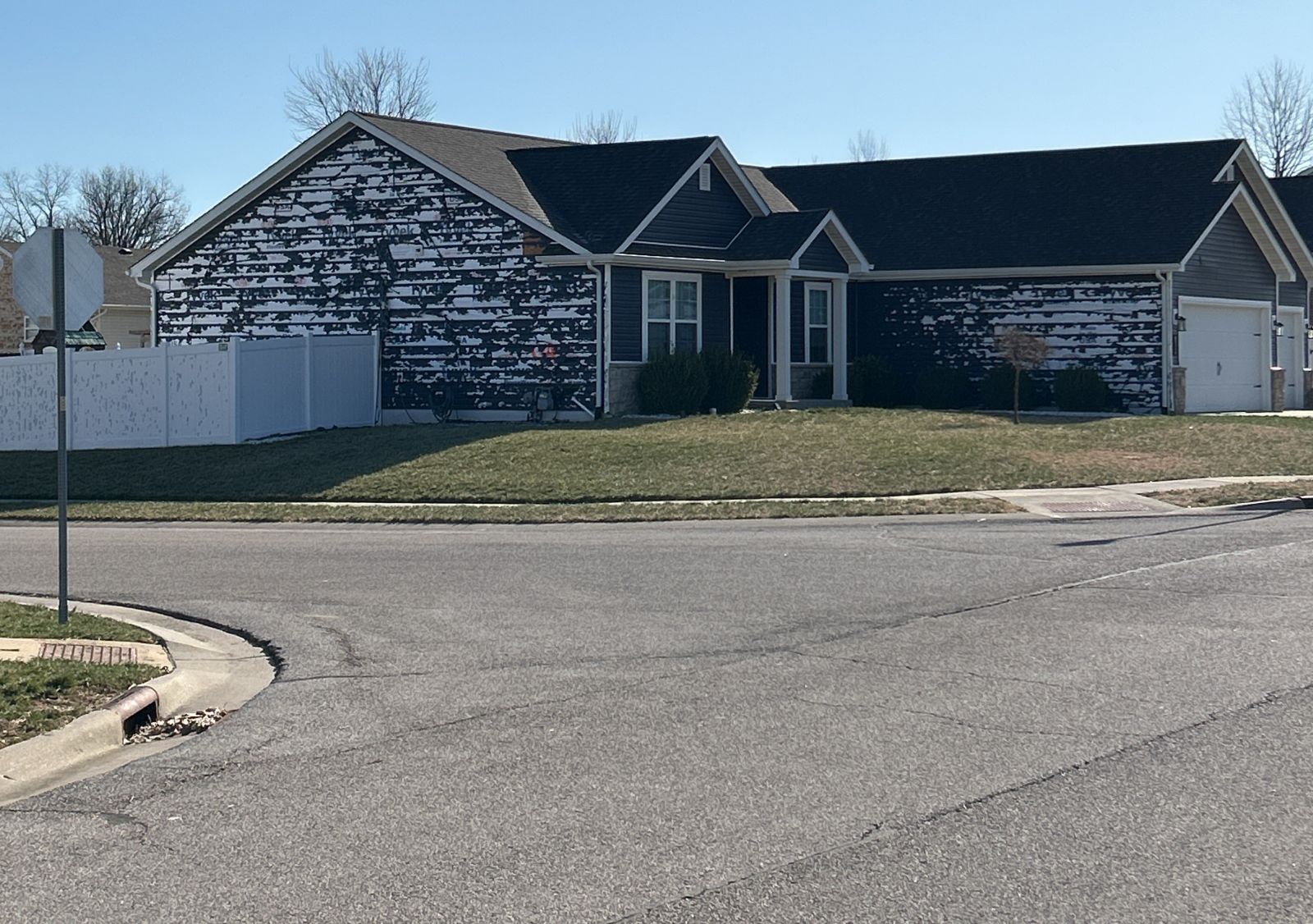
Photograph by the National Weather Service storm survey team. [13]
Consider Ana’s hypothetical house. Her declarations show a $350,000 dwelling limit, a $1,000 all-other-perils deductible and a separate 2% wind-or-hail deductible based on the dwelling limit. For this example, the insurer accepts hail as the cause, applies the wind-or-hail form, and values the covered repairs at $18,500. There are no other adjustments or prior payments. The deductible is $7,000. Subtracting it from $18,500 leaves $11,500.
Ana can now explain the number in one sentence. “The insurer used the wind-and-hail line, took 2% of my $350,000 dwelling limit and deducted $7,000 from $18,500 of covered damage.” If a piece of that sentence is missing, she knows where to look. An unexplained $7,000 asks for a base and a rate. An unexplained $18,500 asks for the scope and valuation. An unexpected choice of line asks for the trigger language and loss facts. These are three distinct questions to send to three different places in the claim file.
Now change one assumption. The adjuster agrees there is $5,800 in covered damage, with the same $7,000 deductible. The simplified result is zero. It does not turn into a bill for the remaining $1,200 from the insurer. If the homeowner contracts for the $5,800 repair, that agreement is a separate obligation. Ask for the written calculation and the process for supplying additional documentation if more damage is discovered. Keep the explanation with the estimate. [2] [5]
Change a different assumption. A contractor estimates $24,000 while the insurer’s estimate remains $18,500. The deductible is still $7,000 under these assumptions. The new $5,500 difference belongs in a comparison of the two scopes. One estimate may include flashing, gutters, permit charges or work beyond the insured damage. Have each party identify quantities and unit prices. An argument about whether 2% is fair will not resolve a missing gutter line. Conversely, proof that a gutter is damaged will not settle which deductible the policy assigns to the event.
5. Why can the first check be smaller than covered repairs minus the deductible?
Look for separate lines for replacement cost, actual cash value, depreciation, limits, prior payments and the deductible. The Texas Department of Insurance describes the distinction between replacement-cost and actual-cash-value coverage and explains why it matters for roofs. Your own settlement form controls which adjustments appear and whether any withheld amount can become payable later. [5]
Consider an explicitly simplified statement. It shows $18,500 estimated replacement cost, $3,200 depreciation, a $7,000 deductible and no prior payment. The initial calculation is $18,500 less $3,200 less $7,000, or $8,300. The difference between the repair price and the first check is $10,200. Only $7,000 of that is the deductible. Whether the remaining $3,200 can be recovered depends on the policy and compliance with its conditions. Ask which part is recoverable, what evidence is required and which dates matter. Never budget against the entire $3,200 solely because it appears on a preliminary estimate.
Now picture two letters arriving in one envelope. One lists both replacement cost and actual cash value. The other includes a payment. Lay the payment stub beside the valuation letter and connect each dollar line once. If you start with the actual cash value of $15,300, depreciation has already been taken out. Subtracting the $3,200 again would understate the payment. If you start with the replacement cost, include depreciation once. This small bookkeeping distinction prevents a surprisingly large disagreement.
A contractor’s deposit is another number that can look like a deductible. A roofer may ask for $4,000 to order materials. That is a term of the repair arrangement. It does not establish that the insurance deductible is $4,000 or that the adjuster’s calculation should decrease by that amount. Keep contractor invoices, insurance estimates and payment records in separate folders. On your running cash-flow sheet, show who will receive each dollar and why. It is easier to see what you can commit to when a repair deposit is not disguised as an insurance adjustment.
6. How do I know which weather event activates the deductible?
Take the heading seriously and then read the definition. “Windstorm or hail” may describe a cause of loss. A hurricane deductible can depend on an official designation, geography and timing. A weather app’s red warning, a news headline or storm damage in another county may provide context. None substitutes for the words of the applicable form. If the insurer applies a special deductible, ask it to identify the paragraph and the facts that make the paragraph apply. [1] [4] [8]
New York illustrates how specific that question can become. Its Department of Financial Services explains a hurricane trigger tied to landfall in New York and a defined time window. Its 2026 circular letter identifies February 2, 2026 as the date from which updated standards apply to policies issued or renewed. The term of the policy matters alongside the date of the storm. For a New York address, the two sources belong together. A Florida homeowner should consult Florida’s provisions instead. [8] [10]
Suppose the homeowner heard high winds overnight and discovered missing shingles at noon. A helpful description separates those times. “I heard wind between approximately 10 and 11 p.m. I first saw the missing shingles at noon when I was able to look from the driveway.” That account gives an adjuster more to work with than “It was definitely the named storm.” If there are timestamped photos, an inspection report or a documented earlier repair, list them in chronological order. A file can contain uncertainty without being disorganized.
Where more than one cause is under discussion, ask how each affected part of the estimate. Wind damage and flood damage can involve different coverage. Do not assign everything with a common date to one deductible because it happened during the same storm. You can describe what you saw, where water appeared and when you found it. Leave the insurer to state its coverage position, with the relevant terms and explanation. Maryland’s disaster FAQ addresses the distinction between wind and flood and the importance of checking actual deductibles. [4]
7. What changes if I have a separate wind policy?
Look at the name of the company on each declarations page. In parts of North Carolina, a primary residential policy can exclude windstorm and hail, and some owners buy separate coverage for those risks. The North Carolina Department of Insurance explains that the separate wind policy carries its own deductible. A homeowner could therefore be looking at a perfectly valid declarations page from the wrong insurer when trying to price a wind claim. [6]
For example, Ellis has a primary homeowners packet and a separate coastal wind policy. The primary declarations list a $1,500 deductible. Ellis highlights it, photographs it and sends the picture to the roofer. That does not settle how the wind insurer will handle the roof. Ellis first needs the wind declarations, the insured property schedule and the provisions for wind loss. If both insurers are involved, record each claim number with the issuing company’s name. A response from one adjuster belongs with that policy until the adjuster explains otherwise.
TWIA provides a second, separate example. Its annotated declarations identify a per-item, per-occurrence deductible. Its sample dwelling policy describes applying the deductible shown for the item to the loss on that item. That wording is a reason to look at an item schedule. It is not a general rule that a deductible applies to each damaged shingle, room or invoice. The word “item” gets its meaning from the schedule and contract. Ask the adjuster to identify the item exactly as it appears on the declarations. [3] [7]
Assume, solely to illustrate that form of calculation, a policy separately schedules two buildings. Building one has $12,000 of accepted damage and a $4,000 scheduled deductible. Building two has $3,000 of accepted damage and a $1,500 scheduled deductible. Applying the example’s terms to each produces $8,000 and $1,500 respectively, before other adjustments. Someone who combines the damage and subtracts only $4,000 gets $11,000, an answer that does not follow those assumed terms. A conventional homeowners form may handle the same physical property differently. Start with the actual item wording before doing either calculation.
8. What happens if there are two storms or two estimates?
Two estimates do not necessarily mean two occurrences. A revised estimate can reflect a second inspection of damage assigned to the first loss. Two storms do not automatically mean one occurrence either. If an insurer treats losses separately, ask for the dates, property, evidence and contract provision used for each. You want a record detailed enough to show which part of the work belongs to which claim. This is particularly useful if an estimate shows damage to the same side of the house on both occasions.
Consider a supplement rather than a second storm. The first estimate accepted $12,000 in covered repairs. A $5,000 deductible produced a $7,000 payment. The inspector then approves $4,000 more in work for that same covered loss. Assume the policy calls for one deductible in this example, with no depreciation or other changes. The revised total is $16,000. Subtracting the original $5,000 deductible gives $11,000 for the whole loss. Subtracting the $7,000 already paid gives $4,000 still due. The second statement may show the deductible again to explain the cumulative total. Its appearance on two pieces of paper does not prove it was taken twice. Compare the payments.
Now consider a location with hurricane-specific annual provisions. Florida’s Department of Financial Services explains the calendar-year operation of its residential hurricane deductible and the conditions that govern subsequent covered hurricane losses. A policyholder dealing with a later hurricane may need the earlier loss calculation, even where the earlier loss produced no payment. Keep the claim records and ask the insurer how any previous amount was credited. Read Florida’s guidance for the particular circumstances, including continuity of coverage. Do not apply that example to ordinary hail in another state. [9]
A useful one-page log has the date first observed, insurer, claim number, amount of accepted covered loss, deductible applied, payments issued and remaining questions. If the insurer says an amount was applied earlier, ask for the statement showing the credit. If it identifies a new occurrence, start a new row. This is a way to understand the insurer’s position. Your headings do not decide the legal or policy question.
9. What should I ask for in writing?
Ask for enough information to reproduce the calculation on paper. “Please identify the policy form and page that set the deductible, the covered location or scheduled item, and the event that triggered that provision. Please show the percentage or fixed amount, the dollar base if applicable, and the resulting deductible. Please also show the covered amount before the deductible and any depreciation or previous payment you applied.” You can shorten that request to the one field you are missing.
Attach the relevant page when it will clarify which entry you mean. Suppose declarations page two says 1% and the estimate shows $6,600. If the limit you copied was $330,000, the arithmetic suggests $3,300. Ask which limit, percentage and policy period produced $6,600. The answer could point to a revised declarations page, a different insured item, a second percentage, or an error. A precise question gives the recipient a chance to find the right document without first having to defend a conclusion you have already drawn.
If the answer addresses the deductible but leaves the scope unresolved, acknowledge that distinction in your next message. For instance, “I can now reproduce the $7,000 deductible. My remaining question is why the estimate includes 80 linear feet of gutter when the contractor documented 110.” Send the relevant measurement or invoice separately. Matching each question to a document is often more effective than sending a large packet with a broad request to reconsider everything.
If you still cannot reconcile the result, ask the insurer where to submit a written review request and how to obtain its response. The state insurance department may offer consumer assistance. The NAIC maintains a directory for finding the regulator for the state where the insured property is located. A state regulator can explain its process. A claim inquiry does not automatically extend any time requirement in a policy or under state law. If a deadline or significant legal dispute is involved, consult an appropriately licensed professional about your situation. [11]
10. How can I compare deductible choices at renewal?
Use the new declarations or actual quotes, the same insured location and the same relevant base. When comparing two insurers, first line up the covered causes of loss and settlement provisions. A 1% roof deductible paired with actual cash value and a 2% deductible paired with replacement cost can produce different results for reasons that have little to do with the percentages. Ask for the specimen forms or endorsement descriptions that explain the differences. [2] [5]
Take two hypothetical renewal offers. Both insure the dwelling for $400,000 and otherwise provide the same assumed wind coverage. One has a 1% wind deductible and costs $2,180 per year. The other has a 2% wind deductible and costs $1,940. The dollar deductibles are $4,000 and $8,000. The second offer saves $240 per year while increasing the household’s share of a sufficiently large covered loss by $4,000. Those are the two numbers worth comparing. The phrase “just one percentage point” hides the size of the emergency expense.
A small loss produces a different comparison. With $6,500 in agreed covered damage, no other adjustments and the example’s $4,000 deductible, the simplified payment is $2,500. The $8,000 deductible would produce zero on that same loss. With a $20,000 covered loss, the simplified payments would be $16,000 and $12,000. These examples illustrate the stakes without forecasting whether a storm will happen. A decision should consider the money the household could actually produce during repairs, as well as what it would save in an uneventful year.
Compare quotes in writing before the renewal becomes effective. Ask how the base would change if an inflation adjustment or change to the insured limit takes effect, and whether a special wind or hurricane deductible would remain. If you elect to change coverage, keep the issued documents showing when the change took effect. A conversation about a future option does not tell you what was in force on the date of a past loss. Keep those two discussions in separate email threads or folders.
A worksheet you can fill out without sharing your policy
Use four short entries on the first page of your notes. First, identify the address, policy period and date the loss was first noticed. Second, quote the deductible entry and list its page or endorsement. Third, show the arithmetic, such as “$350,000 dwelling limit × 0.02 = $7,000.” Fourth, write the settlement calculation in the insurer’s order, with a separate line for each adjustment and prior payment. If something is unknown, leave a blank and write a precise question beside it.
Below the calculation, make two lists. “Insurance documents” might contain a renewal packet, endorsement and estimate dated October 18. “Repair documents” might contain a roofer’s measured diagram, photographs and an invoice for temporary protection. A difference in price can be investigated with the second list. A difference in the deductible provision needs the first. If you can identify the list you need, the next call is usually shorter.
For a household handling the claim together, choose one place to keep the latest worksheet and date each revision. Keep a copy of the older version when a new estimate arrives. Consider how you would explain the change to someone who missed the adjuster’s call. “They raised the number” leaves them guessing. “They increased the accepted siding quantity by 150 square feet and left the wind deductible at $5,000” tells them exactly what changed. The distinction matters when one person is talking to the roofer and another is paying the bills.
Before agreeing to a repair amount, look down the worksheet for unconfirmed money. A possible supplemental payment, recoverable depreciation subject to conditions, or coverage your agent is still checking belongs in a separate column from money already received. That habit will not decide your claim, but it will keep you from promising a contractor dollars you may never receive. If you have one unresolved question, write it at the top instead of carrying it as an assumption into every calculation below.
Frequently asked questions
Does 2% mean I owe 2% of the repair bill?
Read the specified base. If it is the dwelling limit, multiply that limit by 0.02. A $300,000 dwelling limit produces a $6,000 deductible even when the repair estimate is $20,000. Multiplying $20,000 by 0.02 calculates $400, which does not follow that sample contract. If your policy uses another base, use the one it specifies. [1] [2]
My declarations show both a percentage and a dollar figure. Which one should I use?
Check the headings, location and effective date, then see whether the figures agree. If a 2% deductible appears next to a $400,000 base and an $8,000 figure, the numbers reconcile. If they do not, ask the insurer for the written calculation and identify the exact conflict. In New York, the regulator specifically addresses disclosure of hurricane deductibles in dollar amounts on the declarations. [8]
Do I pay a deductible directly to my insurance company?
Look at the settlement statement and repair agreement separately. An insurer may subtract the deductible when calculating what it pays. You can then owe the contractor your share of the repair price under your agreement. Ask who is requesting a payment, for which work, and under which document. The Texas home insurance guide gives an example of the insurer’s subtraction. [5]
If the adjuster agreed there was storm damage, why did I receive nothing?
Accepted damage may fall below the applicable deductible. Coverage exclusions, limits and other determinations can also change a payment. Ask for a written explanation stating the accepted amount, provision and calculation. A zero-dollar check alone cannot tell you which decision the insurer made. Keep the letter in case you later receive a revised estimate. [2] [5]
Does my neighbor’s deductible tell me anything about mine?
It can suggest a question to ask, but it cannot establish your result. Even neighboring houses can have different policy terms, deductible elections, dates or insured limits. Two people who both chose 2% can have different dollar deductibles because their applicable insured values differ. A coastal property may also have a separate wind policy. [1] [6]
Can I use the same formula for my detached garage and the contents?
First see whether the policy applies one deductible to the loss or separate amounts to individually scheduled items. Check the page that lists that specific structure or property. TWIA’s instructional material and sample policy illustrate how per-item wording can work. Those documents do not establish how an unrelated insurer’s homeowners form handles a garage. [3] [7]
If the estimate is revised, do I subtract the deductible again?
Determine whether the new document is a cumulative statement for the same loss or a calculation for another occurrence. In a cumulative statement, reconcile the revised covered total, applicable deductible, other adjustments and previous payments. Compare the amount now due with what was actually paid. If the insurer treats something as a second loss, ask which date, cause and provision support that distinction.
How do I report damage or ask for help?
Notify your insurer through the claim channel on the policy or its official site. Storm Help Center publishes information and can accept a separate, non-urgent inquiry. The site cannot file a claim for you, change its amount or confirm your insurer’s deadline. For questions about these resources, use our contact page. Keep claim numbers, policy files and sensitive records off a general website form. [12]
Sources and further reading
[1] National Association of Insurance Commissioners, Hurricane Deductibles
[2] Texas Department of Insurance, What to know about deductibles
[3] Texas Windstorm Insurance Association, Inside a Policy
[4] Maryland Insurance Administration, Post-disaster claim questions
[5] Texas Department of Insurance, Home insurance guide
[6] North Carolina Department of Insurance, Windstorm and Hail
[7] Texas Windstorm Insurance Association, sample dwelling policy
[8] New York Department of Financial Services, Basic Coverage and Adding Coverage
[9] Florida Department of Financial Services, Florida’s Hurricane Deductible
[10] New York Department of Financial Services, Insurance Circular Letter No. 1 (2026)
[11] National Association of Insurance Commissioners, State Insurance Departments
[12] Storm Help Center, Contact
[13] National Weather Service St. Louis, March 14, 2025 storm survey photographs